
Whakataukī
Kotahi te aho ka whati, ki te kāpuia e kore e whati.
One strand of flax is easy to break, but many strands together will stand strong.
— Kīngi Tāwhiao
Version 0.3
Developed by Manaaki Whenua – Landcare Research

Whakataukī
Kotahi te aho ka whati, ki te kāpuia e kore e whati.
One strand of flax is easy to break, but many strands together will stand strong.
— Kīngi Tāwhiao
The New Zealand Land Use and Management (NZLUM) classification system adapts the Australian Land Use and Management (ALUM) classification for New Zealand.
ALUM provides a strong data structure for standardisation. Its CC-BY 3.0 Australia Licence explicitly allows adaptation. While some ALUM classes are retained, and the basic structre of the classification system is familiar, NZLUM significantly adapts some classes and adds new classes and attributes relevant to New Zealand.
Key Changes from ALUM v8:
The rationale for this adjustment is to recognise situations where water is a land cover occuring on a wider land use (such as a reservoir on a farm), and to recognise irrigation more consistently as a farm management practice, and not a land-use in itself.
Rather than defining water as a land-use class, as in ALUM, NZLUM records it as an attribute with a controlled vocabulary (i.e. using terms, lake, reservoir, river, wetland, marine).
including subtypes (e.g., lake hydro).
NZLUM follows ALUM’s approach of using attributes of land-use to record additional information. These take the form of “land management practices” or “commodities”, and adopt defined terminology.
Such attributes are considered optional, but they should be included where information permits.
land_estate and land_status reflect ownership or rights affecting land use.Attributes are categorical.
Nothing in this specification should prevent the extension (widening) of the data representation, e.g. to include continuous data to accomodate stocking rate information, demographic information, or other attributes.
Classes in NZLUM are hierarchical by design, this allows for both the aggregation of broad land-use categories and the disaggregation of specific subclasses for analysis and reporting.
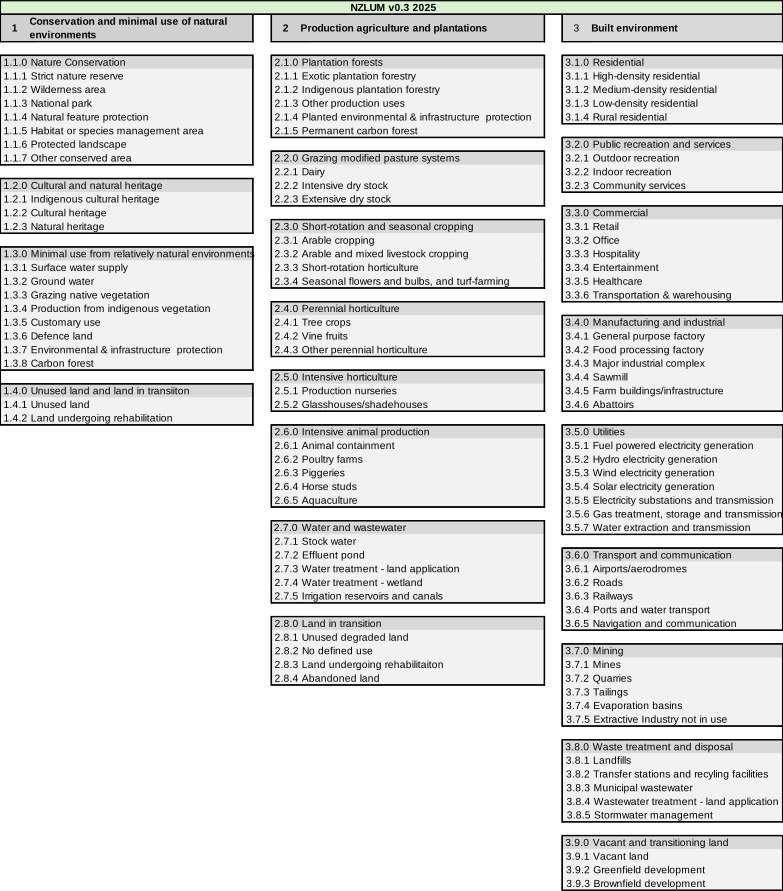
Classes are arranged hierarchically:
Each subclass adds definitional precision.
At the highest tier, NZLUM divides land into three main primary classes, reflecting the degree of modification and purpose of use:
Land with a relatively low level of human intervention. May be reserved by government for conservation, or protected under other legal or administrative arrangements. Areas can have multiple uses, but nature conservation is central. Some land may remain unused due to deliberate choice or circumstance.
1.0.0 Conservation and Minimal UseLand used primarily for primary production, where native vegetation has largely been replaced by introduced species through clearing, sowing, or fertiliser application. Includes plantation forestry, pasture, cropping, fodder, and a wide range of horticulture. If irrigation infrastructure or water-take consents exist, record irrigation as a management practice even if it has not been recently applied.
2.0.0 Production Agriculture and PlantationsLand uses involving high levels of modification of natural processes, typically associated with settlements and infrastructure. Such activities can substantially remodel vegetation, surface and groundwater systems, and terrain to support urban, industrial, or service functions.
3.0.0 Built EnvironmentClassification of land-use class can include categorical attributes describing:
cattle beef, kiwifruit, pineirrigated, wintering off, organicland_estate or land_statussealed / unsealed1 Cavanagh J, Whitehead B 2022. Land-use classification for state of the environment soil-quality monitoring. Manaaki Whenua – Landcare Research LC4146. https://www.envirolink.govt.nz/assets/Envirolink/2222-GSDC170-Land-use-classification-for-state-of-the-environment-soil-quality-monitoring-and-reporting.pdf
2 Cavanagh J, Whitehead B 2023. Enabling flexibility and connectivity in land-use classification. Manaaki Whenua – Landcare Research LC4309. https://www.envirolink.govt.nz/assets/Envirolink/R18-4-Enabling-flexibility-and-connectivity-in-land-use-classification-for-state-of-the-environment-soil-quality-monitoring.pdf
3 Rutledge D et al. 2016. Waikato Integrated Scenario Explorer (WISE). Waikato Regional Council Tech Report #3506882.
4 Price R, Rutledge D, Fraser M 2010. New Zealand Land Use Database. Envirolink Project LCRX0901.
5 MfE 2019. National Planning Standards. https://environment.govt.nz/publications/national-planning-standards/
6 LINZ 2010. Rating Valuations Rules 2008 (v1 Oct 2010) – LINZS30300. https://www.linz.govt.nz/resources/regulatory/rating-valuations-rules-2008-version-date-1-october-2010-linzs30300